
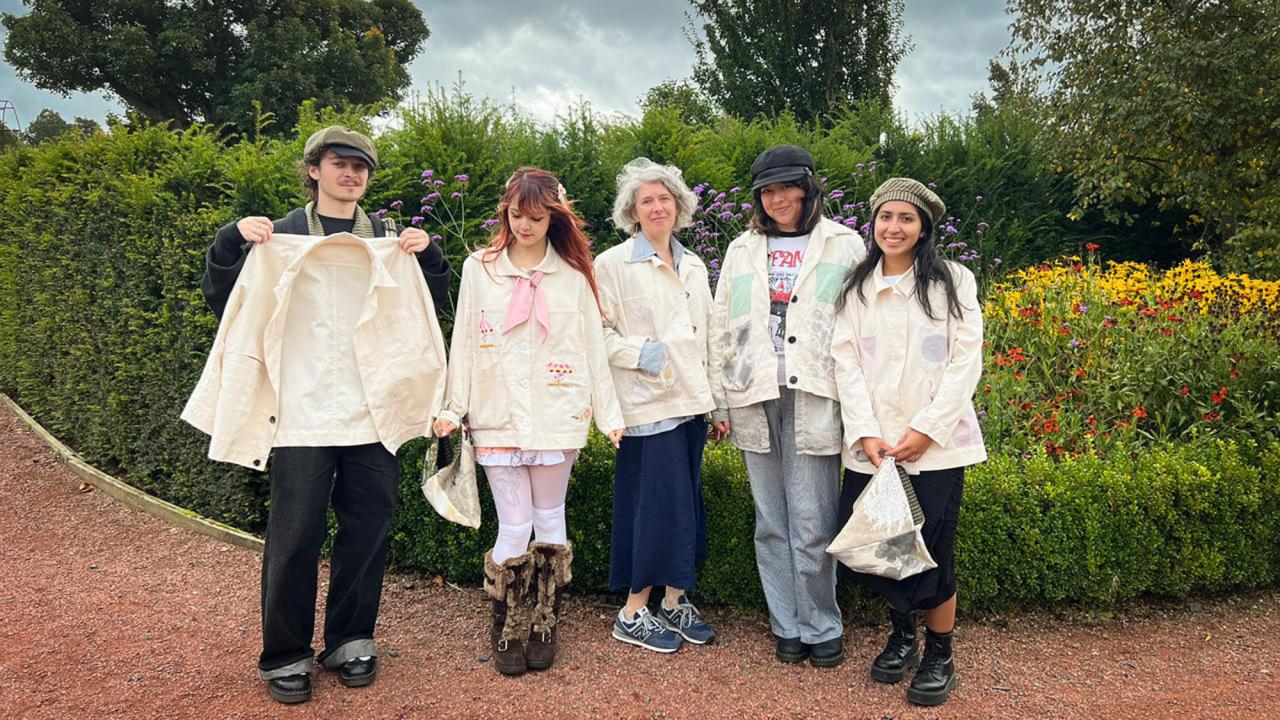
In a small Scottish village on the vast estate of King’s Foundation, filled with green grasses, manicured gardens and roaming farm animals, a group of UC Davis design students experienced first-hand what local and sustainable fashion looks like in the U.K.
A first-of-its-kind residency, completely free for students, the Planet Positive Residency sent 10 distinguished students focusing on fashion and textile design to the King’s Foundation, Dumfries House in Scotland, for a week this fall to learn how traditional Scottish artisans, craftspeople and designers work with natural textiles and dyes. The residencies were funded by the Maria Manetti Shrem Foundation, which funds various UC Davis arts.
“They were able to engage with the farmers who grow, who herd the sheep, breed the sheep, so they were able to see all the faces of the textile and fashion industry from where it starts from the fibers to the high-end finished products,” said Gözde Göncü-Berk, associate professor of design and inaugural Maria Manetti Shrem Endowed Chair in Design, Fashion and Textiles at UC Davis. “It was very inspiring and broadened their perspective and their understanding of the industry."
Applications for the next residency will open in the spring.
Learning ‘slow fashion’
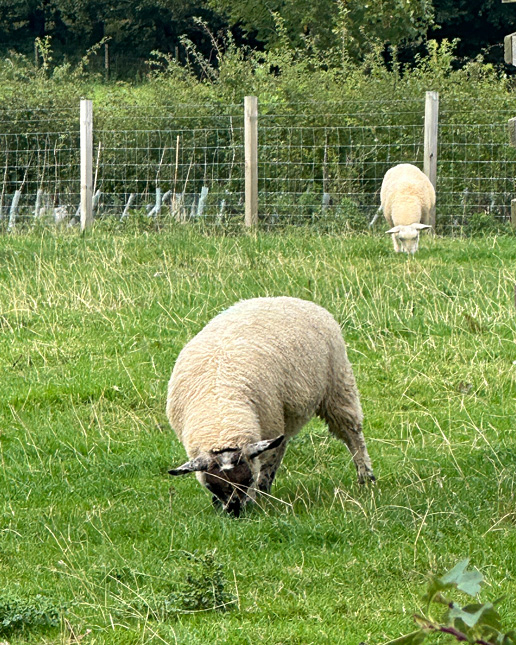
Sheep grazing on a green pasture at the Dumfries House estate (Photo courtesy of Kathryn Choy)
Kathryn Choy, who is majoring in design at UC Davis, is an advocate for what she calls “slow fashion,” especially garments that are handmade, traditional and cultural.
While at the Dumfries House residency, students visited Stewart Christies in Edinburgh, Scotland’s oldest bespoke tailor that specializes in hand-tailored suits, legal and judicial garments, and kilts.
“You could tell there's a lot of care – a lot of consideration, put into these garments,” Choy said. “These are not mass-produced garments. These hold a lot of traditional significance and have a lot of history behind them, so you can really tell that there is a lot of care put in them.”
Seeing that sustainable, handcrafted fashion can be a profitable business was encouraging to Choy, who is particularly interested in working on traditional Chinese cultural garments. As fast fashion has become the norm, consumers expect quality clothing made faster and cheaper than ever before, she said. This usually means a disregard for the context in which a garment is made as well as for the artists and laborers behind its creation.
“By focusing on slow fashion,” Choy said, “it really taps more into the concept of tradition and quality and, also, sustains traditional techniques that can then be passed down from generation to generation, from teacher to student.”
Students embrace natural dyes
Maya Leonard, a communications and design major, enjoys experimentation and playing with designs and techniques that embrace asymmetry. The slower, more intentional processes she engaged with while in Scotland have stayed with her since returning to the U.S. The most poignant of these for her being the natural dye workshop.
“In more corporate, or fast fashion, everything has to be so symmetrical, so consistent throughout everything and, with natural dye, you're never going to get the same color twice – everything's going to be a little different, it's all unique and I really love that,” Leonard said. “I wish we'd appreciate that more, that not everything has to be the same.”
She’s kept up her natural dying practice, learning how different colors and materials can be manipulated to get the desired effect.
“It just gets the gears in my mind going,” she said. “It's really like a science experiment.”
Outside the classroom
Göncü-Berk had never seen her students be as focused as they were while learning and working at the Dumfries House.
“Seeing students experience the environments where textile fibers actually come from — rather than only working with finished materials in the classroom — shifted how I think about teaching and learning,” Göncü-Berk said. “The difference is profound when learning happens outside the classroom, where you can be with the material in a direct, embodied way.”
“I think seeing students so deeply in the flow was the most inspiring thing for me,” she added.
Even when the lessons and field trips were over for the day, she and the students would all gather together in a community room, sitting quietly or talking while they worked on separate projects like knitting, embroidery or sketching.
It was almost as if there was a “collective flow,” Göncü-Berk said.