
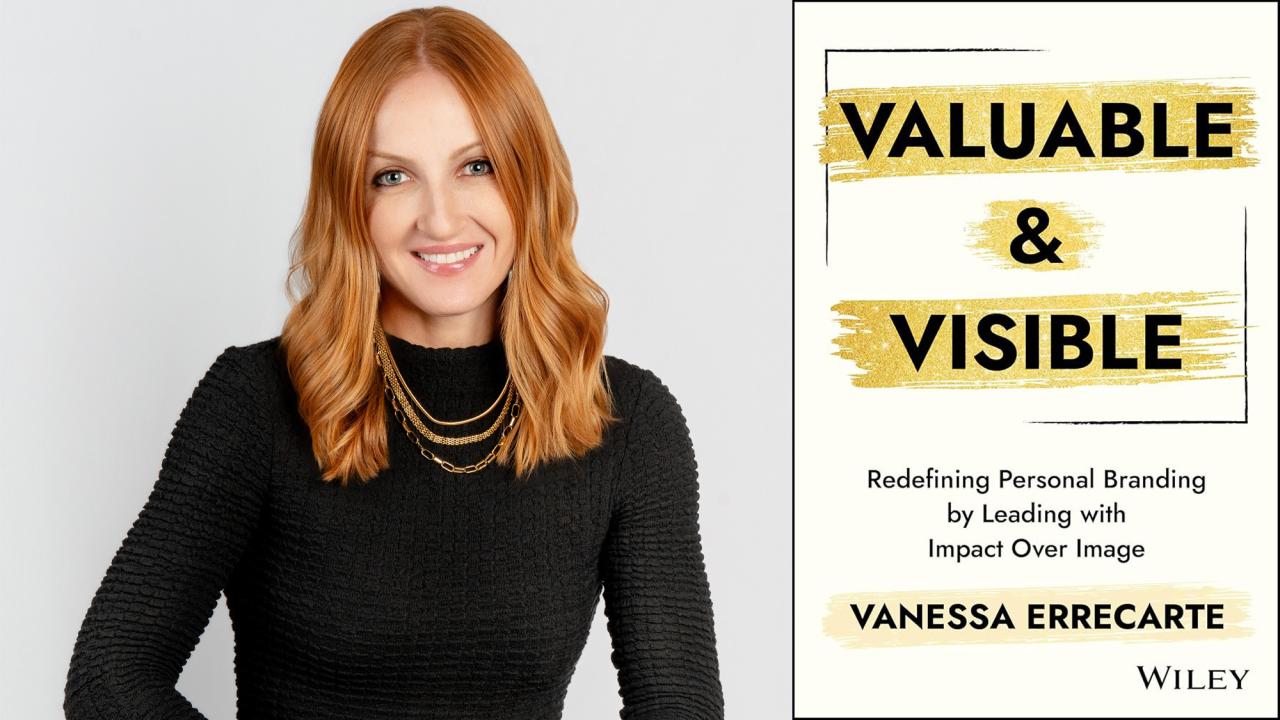
Vanessa Errecarte ’04, M.B.A. ’14, said she was inspired by her students at UC Davis to write her book, Valuable and Visible: Redefining Personal Branding by Leading with Impact Over Image (Wiley, 2026).
A lecturer at the UC Davis Graduate School of Management, Errecarte teaches personal branding and uses the lessons from her courses to write the book. Several students act as case studies, showcasing their success starting a podcast and marketing their photography, among others.
“I love helping students get to where they want to go,” Errecarte said. “I think it’s such a big, hard world, and we have so many wonderful, talented humans.”
According to Errecarte, social media is only one engine for personal branding.
“Despite how much time we spend online, most of us don’t work on our own identity there,” she said. “Most of us don’t own our own URL, for example. You could be [building an audience] with your own type of newsletter for those that you’re teaching and helping.”
Here, Errecarte shares more of how to refine a strategy.
Why did you want to share your tips for personal branding?
What if I told you your personal brand has nothing to do with you and self-promotion but everything to do with the knowledge and information you share to make other people's lives better? If you have a different approach to marketing, let’s find that approach, let’s tease it out. I’ll teach you how to start writing some thought leadership pieces online, you’ll create a website, stuff like that. And then people start noticing you. It’s distinctive thinking, being able to say, “here’s a problem that I see; here’s how I do this a little bit differently.” Knowing how to do that is key. I’m passionate about it because I think a lot of students think that people who seem distinctive or smart or wise are born that way, but it’s actually very teachable.
Who should read this book?
Two major populations that I think this book is for are those job seekers and career pivoters and then entrepreneurs [where] they are their business. This isn’t necessarily for that person who wants a career as an influencer; this is for anybody — this is for you and I, for people who are hesitant and hate self-promotion. There’s a place for them on the internet too. We spend an average of eight hours and three minutes online every single day, emailing, texting, etc. And so, we actually spend more time of our waking hours online than off, yet we don’t figure out a system for how we want to show up and network online. Then, all of a sudden, we’re counting ourselves out of this place where we really need professional visibility. It’s not really optional anymore. Get yourself some visibility based on your value.
Does the book outline kind of activities that people can do?
I tried to do two things in this book. First, we change the perspective of what is a personal brand; then we do the ‘how-to.’ So part one is defining what a personal brand is, finding that brand vision, finding that counterintuitive point of view that you’re going to teach about. Part two is packaging it in your own space, like the website. We also talk about forming frameworks for the things you teach. Most people don’t form frameworks for the things that they know, but the people that do rise in distinction. Part three is about information dissemination. And then part four is aspirational. Part four is the way you’re building this brand. It could very easily become entrepreneurial. I’ve had students, for example, one became a publisher of his own photography in a photo narrative book. Another student is an optometrist. She started educating people about dry eyes. I could go on forever because I’m so proud of my case studies.
How did you learn this?
I learned it by accident. I approached my work differently when I started consulting, I always tried to hide anything about being a mom and my personal life from my business career because I was afraid people would take me less seriously. I think a lot of people do that. But then my daughter was diagnosed with a very serious health condition that could become could have become life-threatening when she was 3. My daughter had early onset scoliosis, which sounds simple, but when you’re 3, an out-of-control spine can collapse your lungs. It can move your heart, so she had to be in a body cast, put under anesthesia, hung in traction. Once every three months she was put in a new body cast, and she would get one day breaks in between. I posted online, “look, this is what Ella’s about to go through.” But then something happened professionally — instead of making it worse for myself, which I thought it would, people actually started sharing more with me about their own vulnerabilities, the goals that they have, but what they think might get in their way. I realized I created this personal part of my brand on accident that almost strengthened my business brand. A client even said to me, I want you more because you’ve been through hard things. That stuck with me.
This interview has been edited for length and clarity.