
Garen Wintemute’s distinguished research career shows that violence is not only a public safety issue — it’s also a health problem.
“It has turned out empirically that violence behaves as if it were a health problem, whether we want to consider it one or not,” said Wintemute. “As such, it can be studied and approached in ways that have concrete benefits. So, if violence is a health problem, then the decision to participate in violence is a health behavior.”
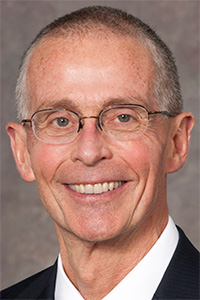
Wintemute is an emergency medicine physician and firearm violence researcher. He’s the inaugural Susan P. Baker-Stephen P. Teret Chair in Violence Prevention at UC Davis School of Medicine and the director of the Centers for Violence Prevention.
Wintemute’s research focuses primarily on gun violence. He's explored the experience of violence among adults in California, perceptions of safety related to firearms in homes and neighborhoods, firearms and dementia, and California’s Gun Violence Restraining Order law.
In 2017, Wintemute led the effort to create the California Firearm Violence Research Center — the nation’s first publicly funded research center to study firearm violence. It’s now one of the branches of the Centers, along with the Violence Prevention Research Program.
Several years ago, Wintemute grew concerned about the possibility of political violence in the United States. In 2022, he started working on a nationally representative survey of adults in the United States on political violence. Wintemute and his team interact with the same people over time, tracking and analyzing trends within individuals. The findings have been alarming.
AMONG THE ACADEMIES
UC Davis has more than 50 faculty members who belong to the National Academies of Sciences, Engineering and Medicine, a recognition of their distinguished and continuing achievements in research. The academies are among the most prestigious membership organizations in the world.
Each month, Dateline UC Davis will profile one of these faculty members in honor of their contributions to scientific research and knowledge.
The team found that sexism, xenophobia, racism, homophobia, transphobia, Islamophobia and anti-Semitism were very strongly associated with willingness to commit political violence. That willingness was turned into an aggregate measure of fear and loathing. This aggregate measure — allophobia, as the team calls it — is known as fear of the “other.”
“We need to focus not on undoing those beliefs, which resist change, but on uncoupling the beliefs from the behaviors associated with them,” said Wintemute. He noted that the surveys have shown that most Americans reject political violence. For Wintemute and his team, this large-scale rejection and a sense of community responsibility are incredibly important.
“That's how it works. It's going to take all of us to keep this violence from happening.”
Using science to serve the community
Wintemute has been part of the UC Davis community since 1973. He attended medical school and completed a residency in family medicine at UC Davis School of Medicine. He received a Master of Public Health degree in 1983 from the Johns Hopkins Bloomberg School of Public Health before returning to UC Davis as a physician.
“We haven't forgotten our origins,” said Wintemute about UC Davis. “We haven't forgotten that we're a public institution, that we serve the people. It's not about us.” Working on the UC Davis Sacramento campus, Wintemute is thankful for his physical proximity to state and local government officials.
“I am one of those scientists who believes that my work as a scientist isn't done when the science is. It's my job to help get this information to the public and to policymakers, people who can do something about it.”
For his entire career, Wintemute has tried to help those around him.
“I was an ER doc before I was a researcher,” said Wintemute. “I see doing research as one of the tools that I have as a physician to help relieve suffering and improve the human condition.”
Wintemute was inducted into the National Academy of Medicine, or NAM, in October.
“He brilliantly translates research findings to inform and evaluate gun violence policies and initiatives that are the basis of major policies at the state and federal levels,” NAM said in its announcement.
Wintemute is thrilled with the recognition, noting the election recognizes and validates the importance of firearm violence as a health problem. While he acknowledged that it’s possible to get discouraged while working to prevent violence, he remains encouraged, especially as he reflects on the team around him.
“Our species is capable of great good, not just great harm,” said Wintemute. “Each one of us gets to decide which side of that balance they're going to be on. I'm going to be on the helping side, and I know that I have lots of company, and that makes me optimistic.”
Media Resources
Rachel LaBud is a writer with UC Davis Health Public Affairs and Marketing, and can be reached by email.