

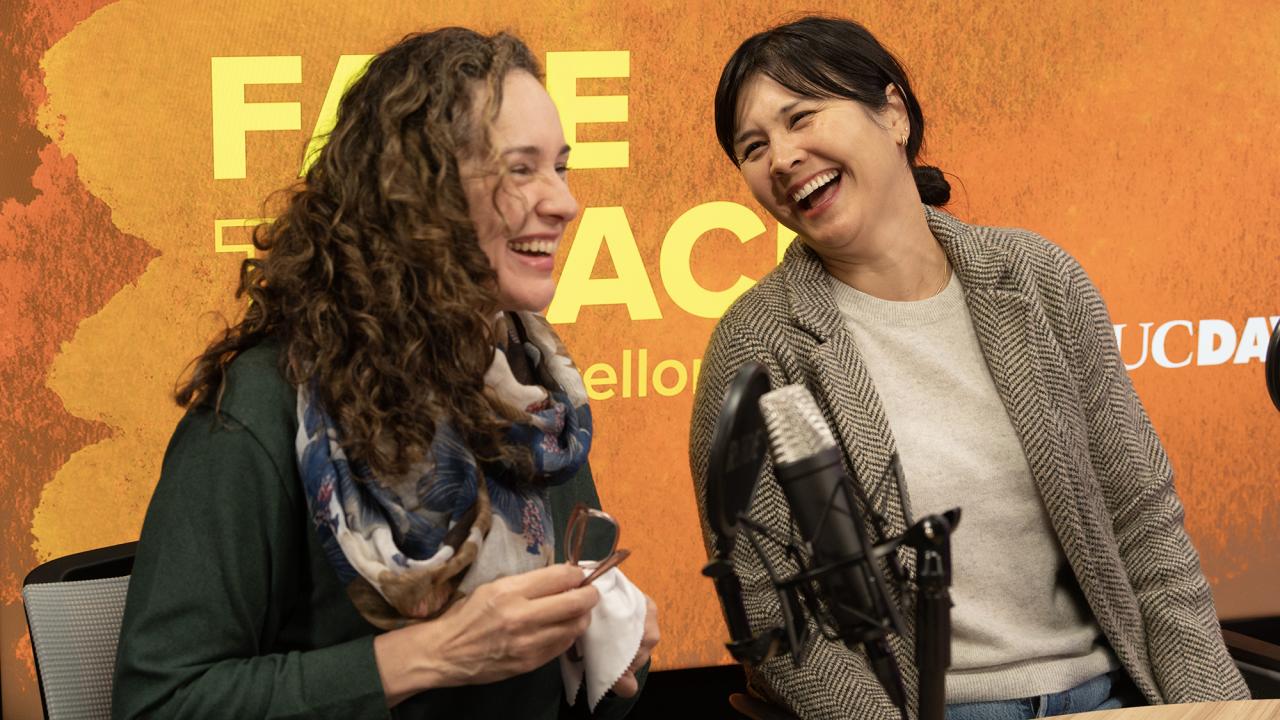
Megan Dennis, associate professor in Biochemistry and Molecular Medicine, and Siobhan Brady, professor in the Department of Plant Biology and the Genome Center, are more than an just office neighbors — they share a similar journey at UC Davis shaped by curiosity, resilience and a commitment to scientific progress. They are this month’s guests on Face to Face with Chancellor May.
Dennis and Brady describe arriving in science as first-generation college students. For them, navigating higher education without a family roadmap presented real challenges. What ultimately sustained them, they say, were strong mentors and supportive research communities that helped them persist.

“I think finding the right team to push you forward [is key] — so not just mentoring, but collaborators and trainees in your group,” Dennis said. “It's being unafraid to take on innovative technologies and open to moving in the direction of wherever the field is taking us.”
From developing potential treatments for genetic diseases to making plants more resilient to environmental stressors, their work highlights how basic research can translate into real-world impact.
As a human genetics researcher, Dennis’ study revolves on understanding how mutations linked to autism affect brain development and behavior. To do this, her lab uses zebrafish as a model system, a choice that often surprises people unfamiliar with genetic research.
“I was always fascinated to learn that I had so much in common with a zebrafish,” May said.
Meanwhile, Brady’s work focuses on how plants respond to rapidly changing environmental conditions.
“We are seeing huge changes in our environments, largely that are the result of human actions, changes in precipitation and temperature,” Brady said. “This is important because if we want to understand how plants cope with this really extreme dynamic fluctuating environment, then we need to understand how plants have been able to survive in extreme environments over evolutionary time.”
Much of this progress, they note, is rooted in sustained federal funding. Dennis points to the Human Genome Project as a landmark example of how publicly funded research can accelerate discovery while creating a shared scientific language across disciplines.
“Without federal funding, our agricultural systems would be struggling and massive cuts in crop yields,” Brady said. “As a result, we'd have increases in human hunger, not to mention changes in the environment that can also affect human life and our ecosystems in general.”
Tune in to hear more about Dennis and Brady’s academic life beyond the lab, how they’re navigating the growing role of artificial intelligence in teaching and research, their advice for mentors and more.

Media Resources
Anila Lijo is a writer and editor for the Office of Strategic Communications, and can be reached by email.